
You spend hours writing the perfect article. Then a reader asks ChatGPT the exact question you answered, gets a neat summary built from three other websites, and never visits yours.
That is the new reality for SEO content writers. Pew Research Center found that Google users clicked a traditional result in just 8% of visits when an AI summary appeared, compared with 15% when it didn’t.
The good news? AI search tools still need great content to build their answers. In this guide, I’ll explain how these tools work, what they look for, and the workflow I teach writers to get their content cited.
Key takeaways
- AI search is mainstream: ChatGPT has 900 million weekly users and Google’s AI Mode has over 1 billion monthly users.
- AI tools break one question into many searches, so covering a topic fully beats targeting a single keyword.
- Google says no special “AI-friendly” writing, llms.txt or markup is needed for its AI features. Helpful, expert content still wins.
- Use AI to speed up research and drafts, but keep a human editor responsible for facts, voice and experience.
The rise of AI search tools
Your readers no longer just type three keywords into Google. They ask full questions and expect a full answer.
The scale is huge:
- ChatGPT: 900 million weekly active users, announced by OpenAI in February 2026 (TechCrunch).
- Google AI Mode: over 1 billion monthly active users, and the Gemini app has 950 million, according to Alphabet’s July 2026 earnings call.
- Fewer clicks: Ahrefs found AI Overviews reduce the click-through rate of the top-ranking page by about 58%.
For writers, that means your audience is increasingly meeting your work through an AI summary, not your page.
How AI search tools actually find and use content
The main tools you need to understand are Google AI Overviews and AI Mode, ChatGPT search, Perplexity, Gemini and Claude with web search. They differ in detail, but most follow the same pattern.
1. They split one question into many searches
Google describes AI Mode’s “query fan-out” as “breaking down your question into subtopics and issuing a multitude of queries simultaneously”. A page that covers the main question and its natural follow-ups has more chances to be picked.
2. They need to be able to crawl your page
Each tool relies on a search index and crawlers. For example, OpenAI says its OAI-SearchBot crawler is what surfaces websites in ChatGPT search. Block it, and your pages won’t appear in those answers.
3. They quote clear, trustworthy passages
AI tools pull the passages that answer a question cleanly and back it up. Research behind Generative Engine Optimisation (GEO) found that adding citations, quotations and statistics improved visibility in AI answers by up to 40%.
What this means for how you write
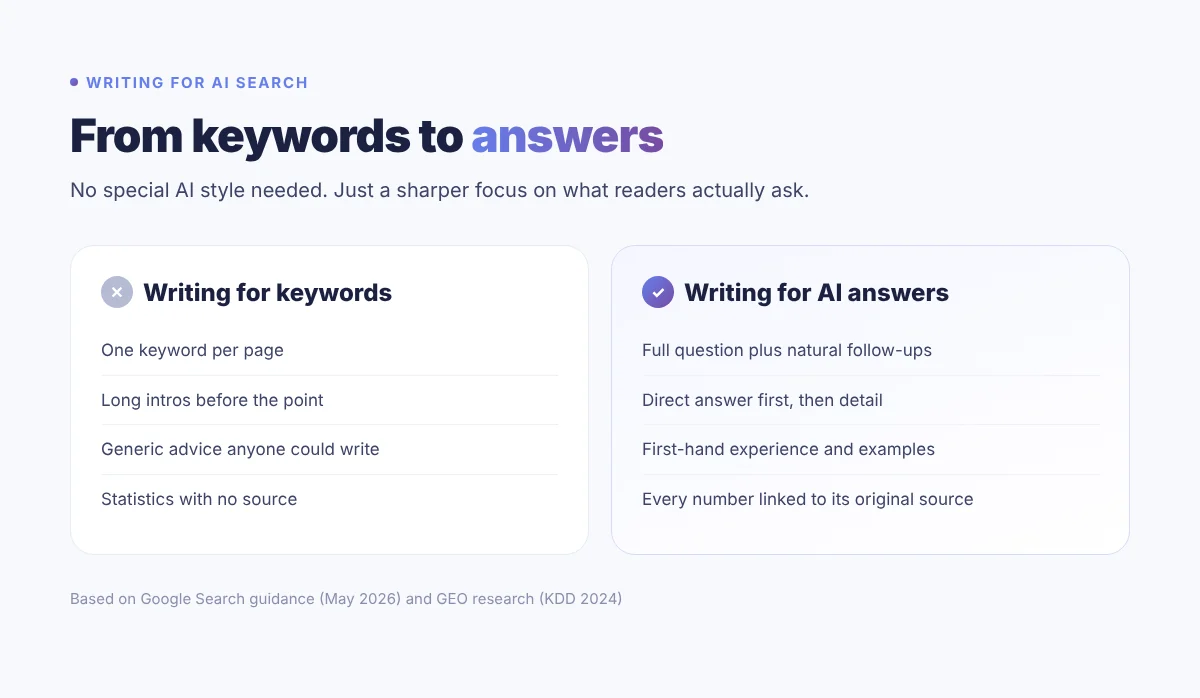
Here’s the part many writers get wrong. You don’t need a special “AI style”.
In May 2026, Google published guidance saying that optimising for its AI search features “is still SEO”. It specifically listed llms.txt files, chunking content for AI and “AI-friendly” writing as unnecessary.
What does change is your focus:
- From keywords to questions. Write for the full question a reader would ask, including follow-ups.
- From padding to answers. Give the answer first, then the detail.
- From generic to first-hand. Add your own experience, examples and opinions. This is what E-E-A-T rewards and what AI can’t copy.
- From claims to evidence. Link every statistic to its original source.
How to use AI tools in your writing workflow: 6 steps
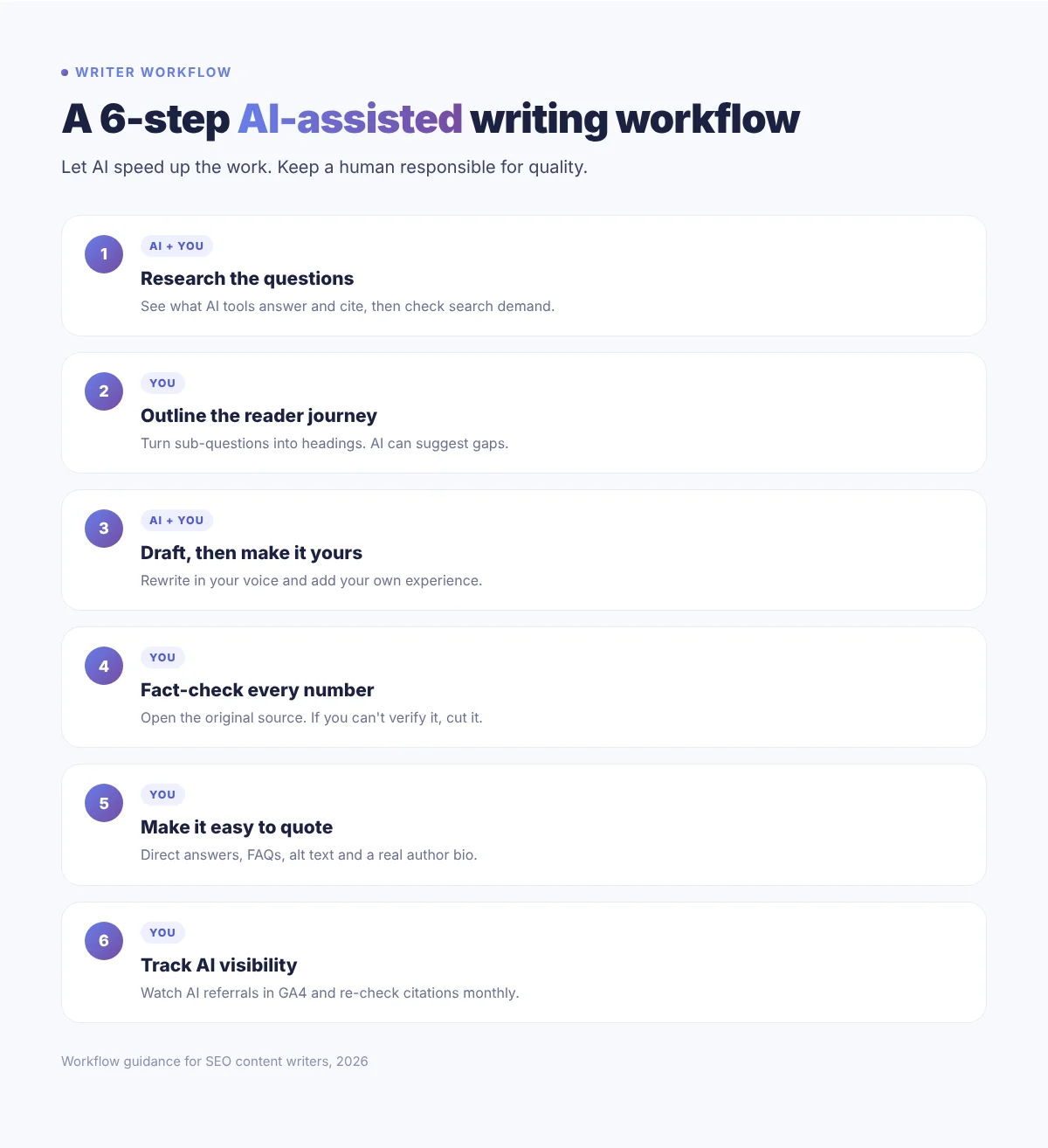
Step 1: Research the questions, not just the keyword
Ask ChatGPT, Perplexity and Google AI Mode the question your article targets. Note the sub-questions they cover and the sources they cite. Then check keyword tools like Ahrefs or Semrush for search demand.
Step 2: Build an outline around the reader’s journey
Turn those sub-questions into H2 and H3 headings. Use AI to suggest gaps, but decide the structure yourself.
Step 3: Draft fast, then make it yours
AI can help you get a first draft down. But rewrite it in your voice and add what only you know: client stories, tests you ran, mistakes you’ve seen. Make sure you follow your company’s AI usage policy.
Step 4: Fact-check every number
AI tools can invent statistics or mix up sources. Open the original study for every figure and link to it. If you can’t verify it, cut it.
Step 5: Make the page easy to quote
Put a short, direct answer under each heading. Add an FAQ section, descriptive image alt text and an author bio that shows real credentials.
Step 6: Track AI visibility, not just rankings
In GA4, watch referral traffic from chatgpt.com, perplexity.ai and gemini.google.com. Re-ask your target questions in AI tools every month and log whether you’re cited. Update the pages that aren’t.
Common mistakes to avoid
- Publishing raw AI drafts. They sound like everything else and add nothing new for an AI tool to cite.
- Chasing “AI hacks”. Special files and formatting tricks are no substitute for genuinely helpful content.
- Blocking the crawlers you need. Check robots.txt and security plugins before wondering why you’re never cited.
- Copying unverified statistics. One wrong number can undermine trust in the whole article.
Frequently asked questions
Which AI search tools should content writers understand?
Focus on Google AI Overviews and AI Mode, ChatGPT search, Perplexity and Gemini. They reach the largest audiences and all build answers from web content.
Do I need to write differently for AI search?
Not in a special “AI style”. Google says optimising for its AI features is still SEO. Focus on answering full questions clearly, adding first-hand experience and linking to sources.
Can I use AI to write my SEO content?
You can use AI to research, outline and draft, but a human should edit, fact-check and add real experience. Unedited AI content rarely offers anything new for readers or AI tools to cite.
How can I tell if AI tools are using my content?
Check GA4 for referrals from chatgpt.com, perplexity.ai and gemini.google.com, and regularly ask AI tools your target questions to see whether your pages are cited.
Conclusion
AI search tools haven’t made content writers obsolete. They’ve raised the bar.
The writers who thrive will use AI to work faster, then add what AI can’t: real experience, verified facts and a clear point of view.
So tell me: when did you last check whether AI tools cite your articles?
Want your content to show up in AI search?
I help businesses become visible in AI search and set up the tracking to measure it. For teams, I also run MQA-approved digital marketing and AI training in Mauritius. Get in touch and I’ll come back to you within 24 hours.
Sources
- Pew Research Center: Google users are less likely to click on links when an AI summary appears (July 2025)
- TechCrunch: ChatGPT reaches 900M weekly active users (February 2026)
- MarketBeat: Alphabet Q2 2026 earnings call highlights (July 2026)
- Ahrefs: AI Overviews reduce clicks (2026 update)
- Aleyda Solis: Google AI Mode’s query fan-out technique
- OpenAI: Overview of OpenAI crawlers
- Practical Ecommerce: Google says AI optimisation is just SEO (May 2026)
- Aggarwal et al.: GEO: Generative Engine Optimization (KDD 2024)