

You can publish a 1,500-word article in under a minute now. So can every one of your competitors.
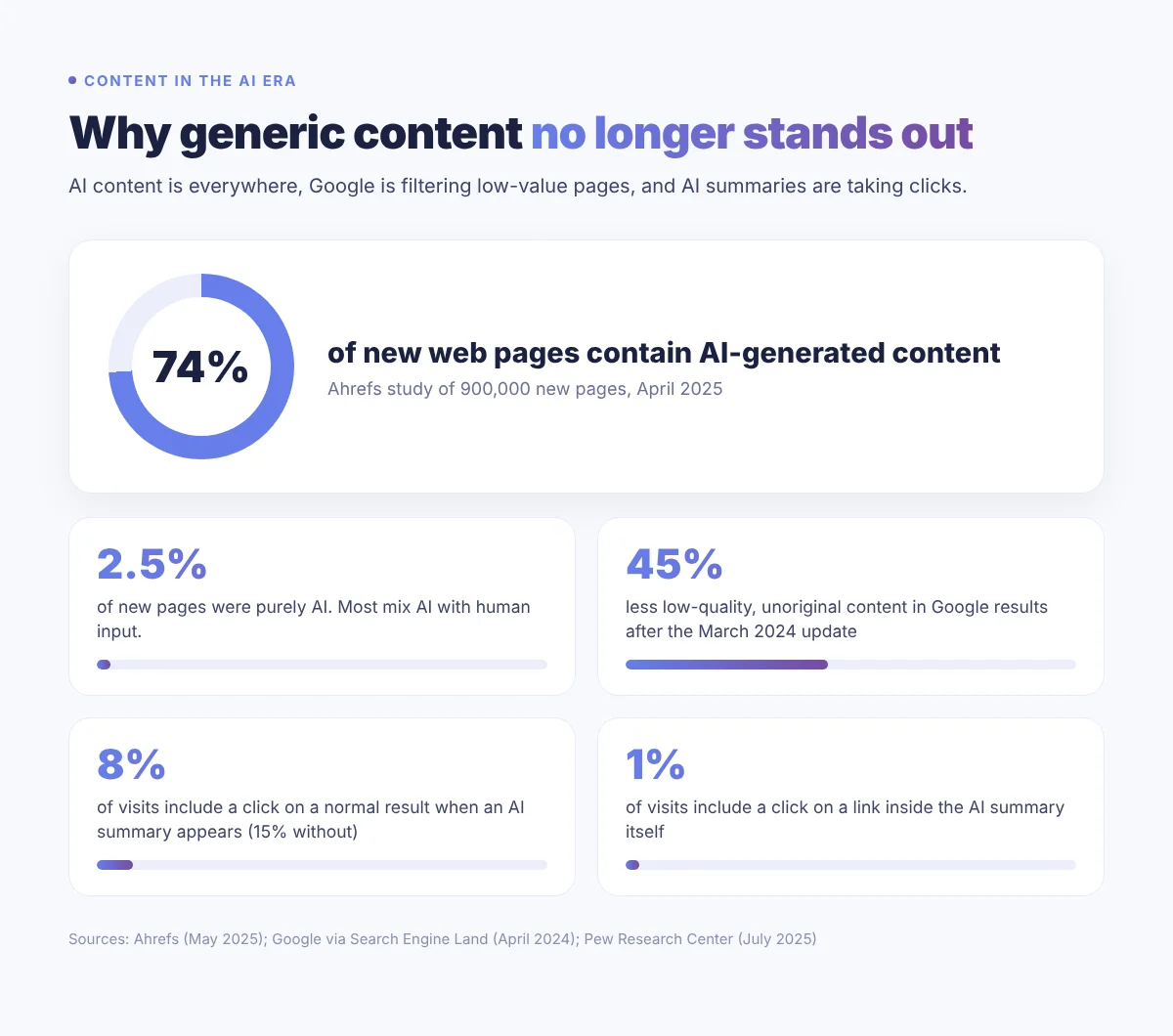
That is exactly the problem. When Ahrefs analysed 900,000 new web pages in April 2025, 74.2% of them contained AI-generated content.
Content is no longer scarce. Real expertise is.
In this guide, I’ll show you what Google’s E-E-A-T framework actually rewards, why AI search makes it matter even more, and the exact steps I use to turn real experience into content that ranks and gets cited.
Key takeaways
- 74.2% of new web pages now include AI-generated content, so generic articles blend into the noise.
- Google added “Experience” to its quality rater guidelines on 15 December 2022, and calls Trust the most important part of E-E-A-T.
- Google does not ban AI content. It penalises low-value, scaled content made mainly to manipulate rankings.
- When an AI summary appears, people click a traditional result in just 8% of visits. Being the cited expert matters more than ever.
The content paradox of 2026
AI made content cheap. That should be good news for marketers.
But look closer at the Ahrefs data. Only 2.5% of new pages were purely AI, while 71.7% mixed AI with human input. Almost everyone is using the same tools, trained on the same internet.
The result is a web full of competent, accurate and completely interchangeable articles. When everything sounds the same, the only thing that stands out is what an AI cannot generate: your lived experience.
What Google’s E-E-A-T actually means
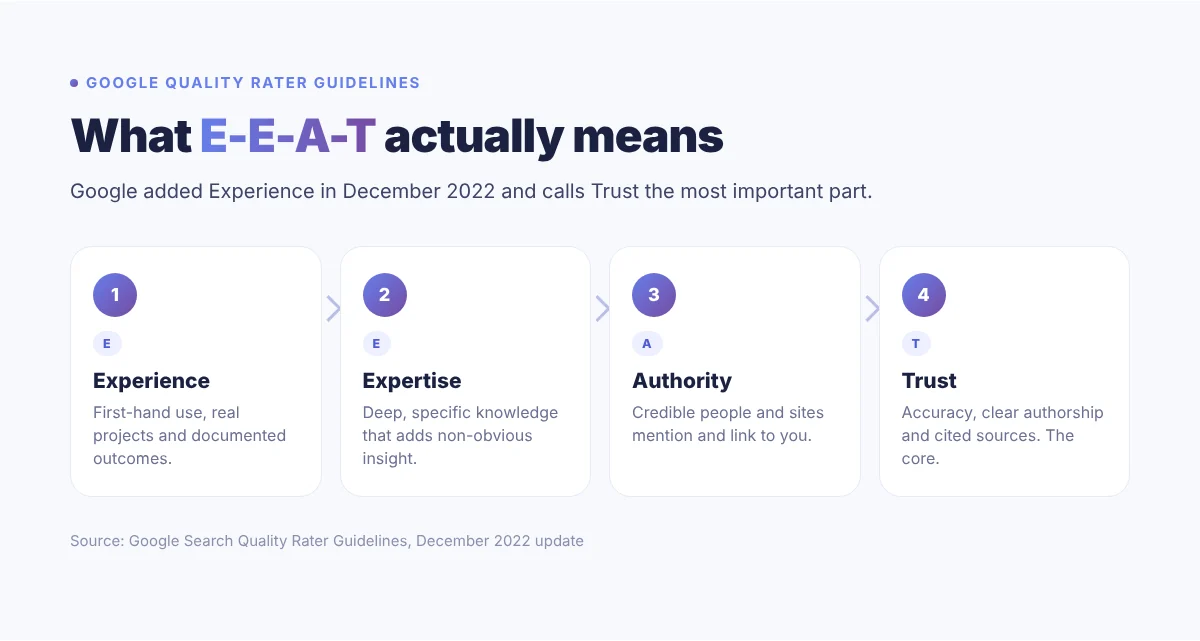
For years, Google’s Search Quality Rater Guidelines talked about E-A-T. On 15 December 2022, Google added a second E for Experience.
One point matters: raters do not rank pages directly. The guidelines describe what Google wants its systems to reward. Here is what each letter means in practice.
Experience
Have you actually done the thing you are writing about? First-hand use, real projects and documented outcomes are signals an AI tool cannot fake.
Expertise
Deep, specific knowledge produces non-obvious insights. Generic summaries do not.
Authoritativeness
Are other credible people and sites referencing you? Mentions, links, interviews and speaking slots build authority outside your own website.
Trust
Google’s guidelines state that “Trust is the most important member of the E-E-A-T family”. Accuracy, clear authorship, cited sources and honesty about limitations all feed it.
Does Google penalise AI content?
No. In February 2023, Google published its guidance on AI-generated content: “Appropriate use of AI or automation is not against our guidelines.”
What Google targets is low-value content produced at scale. Its March 2024 core update introduced a “scaled content abuse” spam policy, and Google later told Search Engine Land the changes led to 45% less low-quality, unoriginal content in results.
So the question is not “Did AI help write this?” It is “Does this add something only a real expert could add?” That is also why I recommend every team has a clear AI usage policy before scaling content.
Why AI search raises the stakes
Search no longer ends with ten blue links. In a Pew Research Center study of 900 US adults, people clicked a traditional result in 8% of visits when an AI summary appeared, compared with 15% without one.
Only 1% of visits included a click on a link inside the summary itself.
That means fewer clicks overall, and the ones that remain go to sources the AI trusts enough to cite. Clear expertise, original data and named authors give AI systems a reason to choose you. This is the heart of Generative Engine Optimisation (GEO).
How to build a human-first content strategy: 6 steps
Step 1: Start every piece with what only you know
Before you write, list the mistakes you have seen, the tests you have run and the opinions you have earned. After 9+ years running performance campaigns for global brands, my best articles always start from a real campaign problem, not a keyword.
Step 2: Use AI for structure, not for substance
Let AI help with outlines, research summaries and editing. Then add the examples, numbers and judgement yourself. If a paragraph could appear on any competitor’s blog, rewrite it.
Step 3: Document results, not just opinions
Case studies with real, permission-cleared numbers are among the strongest experience signals you can publish. Show the starting point, what you changed and what happened.
Step 4: Make the author obvious
Add a named byline, a short bio with credentials and links to your profiles. Google’s helpful content guidance asks whether it is clear to readers who created the content.
Step 5: Build a consistent author entity
Use the same name, photo, title and description on your website, LinkedIn, guest articles and speaker pages. Consistency helps both search engines and AI tools connect your expertise to you.
Step 6: Cite sources and take a clear position
Link every statistic to its original source. Then say what you actually think. Reasoned, specific positions are what people quote, share and remember. If you want to understand how AI tools read and select sources, start with this guide to AI search tools for writers.
The opportunity hiding in the AI content flood
Here’s the upside. When most brands publish the same AI-assisted article, the bar for standing out drops.
You don’t need to out-publish anyone. You need to out-experience them. One honest case study can do more for your authority than twenty generic posts.
Frequently asked questions
What does E-E-A-T stand for?
E-E-A-T stands for Experience, Expertise, Authoritativeness and Trust. Google added Experience to its Search Quality Rater Guidelines in December 2022, and describes Trust as the most important element.
Is E-E-A-T a direct Google ranking factor?
Not as a single score. Quality raters do not change rankings directly. E-E-A-T describes the qualities Google wants its ranking systems to reward, so improving it improves the signals those systems look for.
Will Google penalise my site for using AI to write content?
Not for using AI on its own. Google says appropriate use of AI is not against its guidelines. It acts against low-value content produced at scale mainly to manipulate rankings.
How can I show experience in my content?
Share first-hand examples, original photos or screenshots, real results from your own projects and lessons from mistakes. Add a named author with a clear bio and link to your professional profiles.
Conclusion
AI has made average content free. That makes genuine expertise the most valuable thing you can publish.
Google’s guidelines, its spam policies and the way AI search cites sources all point in the same direction: real people, real experience, real proof.
So here’s my question for you: what is one thing you know from experience that your competitors’ AI tools could never write?
Want content that Google and AI search trust?
I help businesses turn their in-house expertise into expert-led content that ranks on Google and gets cited by AI search. Tell me about your project, or upskill your team with my digital marketing and AI training.
Sources
- Ahrefs: 74% of new webpages include AI content (study of 900k pages), May 2025
- Google Search Central: E-A-T gets an extra E for Experience, December 2022
- Search Engine Land: E-E-A-T and major updates to Google’s quality rater guidelines, December 2022
- Google Search Central: Google Search’s guidance about AI-generated content, February 2023
- Search Engine Land: Google March 2024 core update rollout is now complete, April 2024
- Pew Research Center: Google users are less likely to click on links when an AI summary appears, July 2025