

Most people try ChatGPT once, type “write me a Facebook post”, get something bland and decide it’s overrated.
The tool wasn’t the problem. The prompt was.
When I train marketing teams, I see it every time: swap a vague one-liner for a prompt with context and a clear task, and the output goes from generic to usable.
ChatGPT for marketing works best when you treat it like a sharp junior assistant. Brief it properly and it saves you hours. Brief it badly and you’ll spend longer fixing its work.
Below are 20 copy-ready prompts, grouped by the jobs marketers do every week. Swap the details in square brackets for your own and start testing.
Key takeaways
- Good prompts give ChatGPT a role, context, a clear task, a format and examples. Vague prompts get vague answers.
- The 20 prompts below cover ad copy, social media, email, SEO briefs, customer research, campaign ideas and reporting.
- Treat every output as a first draft. ChatGPT can sound confident and still be wrong, so fact-check before you publish.
- Feed it your brand voice so the copy sounds like you, not like everyone else using the same tool.
- Never paste confidential information or customer personal data into a prompt.
How to write better prompts for ChatGPT
Before the prompts, a quick framework. OpenAI’s own prompt engineering guidance says your prompts should be clear, specific and give the model enough context to understand what you’re asking. It also recommends using descriptive words to set the tone, such as formal, friendly or humorous.
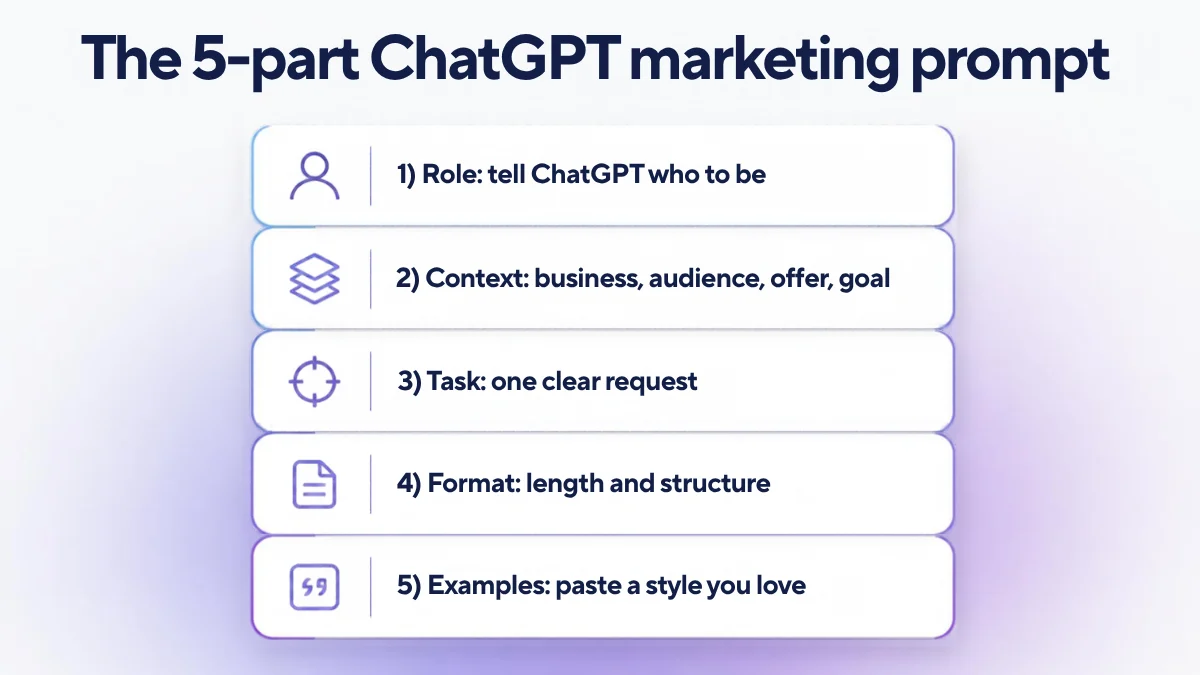
I teach a simple five-part structure that puts this into practice:
- Role. Tell ChatGPT who to be: “You are a senior copywriter for a Mauritian retail brand.”
- Context. Describe your business, audience, offer and goal.
- Task. Say exactly what you want, in one clear sentence.
- Format. Specify length and structure: “5 options as a numbered list.”
- Examples. Paste a post you love so it can match the style.
Then iterate. OpenAI describes prompting as iterative: review the answer, then adjust the wording, add context or simplify the request.
20 ChatGPT for marketing prompts that work
Each prompt follows that structure in compact form.
1. Ad copy
Prompt 1: Ad variations. “You are a performance copywriter. Write 5 Facebook ad primary texts for [business], a [type of business] in [location], promoting [offer] to [audience]. Each under 125 characters, each with a different angle.” Use it when a tired ad needs fresh variations to test.
Prompt 2: Search ad headlines. “Write 15 Google Search ad headlines of 30 characters or fewer for [product] targeting people searching ‘[keyword]’. Include the keyword in at least 5.” Use it when building a new search campaign.
Prompt 3: Offer angle finder. “Here is my offer: [describe offer]. List 10 reasons [audience] might buy it, ranked by persuasiveness, with a one-line hook for each.” Use it when your ads all sound the same.
2. Social media posts
Prompt 4: Weekly content plan. “You are the social media manager for a café in Port Louis that serves office workers at lunchtime. Create a 7-day Instagram plan with one post idea, a caption under 80 words and a suggested visual per day.” Use it on a Monday when you have no plan.
Prompt 5: Brand voice rewrite. “Here are three posts that represent our brand voice: [paste posts]. Describe this voice in 5 bullet points, then rewrite the following caption in the same voice: [paste caption].” Use it when your copy sounds generic and you want it to sound like you.
Prompt 6: Hook generator. “Write 10 opening lines for a short video about [topic] aimed at [audience]. Each under 12 words, designed to stop the scroll.” Use it before filming Reels or TikToks.
3. Email marketing
Prompt 7: Subject lines. “Write 10 email subject lines for a [campaign type] from a boutique in Curepipe announcing [offer]. Mix curiosity, benefit and urgency, each under 50 characters.” Use it when open rates are slipping.
Prompt 8: Welcome sequence. “Plan a 3-email welcome sequence for new subscribers to [business]. For each email, give the goal, subject line, a 120-word draft and one call to action.” Use it when you’re setting up email automation for the first time.
Prompt 9: Win-back email. “Write a friendly, short email to customers who haven’t bought from [business] in 6 months. Remind them of [key benefit] and include [incentive].” Use it to reactivate past customers before paying for new ones.
4. SEO and blog briefs
Prompt 10: Blog brief. “You are an SEO content strategist. Create a blog brief for the keyword ‘[keyword]’ aimed at [audience]. Include search intent, a title, H2 and H3 outline and questions to answer.” Use it before writing or commissioning an article.
Prompt 11: Topic clusters. “My business is [business] serving [audience] in [location]. Suggest 5 topic clusters, each with one main and 4 supporting articles, based on questions my customers ask.” Use it when planning a quarter of content.
Prompt 12: Meta descriptions. “Write 3 meta descriptions between 120 and 155 characters for a page about [topic]. Include the phrase ‘[keyword]’ naturally and end with a reason to click.” Use it when cleaning up pages with missing or weak descriptions.
5. Customer research
Prompt 13: Persona draft. “Based on this description of my customers: [describe], create 3 personas with goals, frustrations, objections and the words they’d use.” Use it as a starting point, then check it against real customer conversations.
Prompt 14: Review analysis. “Here are anonymised customer reviews with names removed: [paste reviews]. Group them into themes and list the top 3 likes and top 3 complaints.” Use it when you have lots of feedback and little time.
Prompt 15: Objection handling. “List the 10 most common objections a [audience] might have before buying [product], with a short, honest response to each.” Use it when building an FAQ page or briefing sales.
6. Campaign ideas
Prompt 16: Seasonal campaigns. “Suggest 5 campaign ideas for [business] in Mauritius linked to [season, holiday or local event]. For each, give a name, core message, main channel and success measure.” Use it when a key date is coming and you want more than a discount.
Prompt 17: Campaign brief. “Turn this idea into a one-page campaign brief: [idea]. Include objective, audience, key message, channels, content list, timeline and KPIs.” Use it when you need to align your team or agency quickly.
7. Reporting and analysis
Prompt 18: Plain-English report. “Here is last month’s campaign data with no customer details: [paste summary table]. Summarise it for a business owner in 5 plain-English bullets, ending with one recommended action.” Use it when explaining results to someone who doesn’t live in Ads Manager.
Prompt 19: Spot the problem. “Compare these two periods of ad results: [paste figures]. Give the 3 most likely reasons performance changed and what to check first for each.” Use it when results drop.
Prompt 20: Test plan. “Based on these results: [paste summary], suggest 5 A/B tests for next month, ranked by impact and ease, each with a hypothesis.” Use it to turn a report into action.
Getting better ChatGPT for marketing copy: keep your brand voice
If everyone uses the same prompts, everyone gets the same copy. The fix is to feed ChatGPT your raw material: posts that performed, the words your customers use, the phrases you’d never say. Prompt 5 is the fastest start, so save the voice description it gives you and reuse it.
Then edit like a human. Add a real detail, a local reference or an opinion only you would have. I go deeper on this in my guide to human-first content.
The limits: what ChatGPT can’t do for you
ChatGPT is a brilliant drafting partner. It is not a source of truth or a safe place for sensitive data.
1. Fact-check everything
OpenAI is open about this. Its help page on whether ChatGPT tells the truth warns that it can produce incorrect or misleading answers, including invented quotes or studies, and that it might sound confident even when it’s wrong. OpenAI recommends treating outputs as a first draft and verifying important information. For marketing, check every statistic, claim, price and date before it goes live.
2. Protect confidential and customer data
Never paste customer names, phone numbers, emails or confidential business information into a prompt. Anonymise first, as in Prompts 14 and 18.
Check your settings too. According to OpenAI’s Data Controls FAQ, you can turn off the “Improve the model for everyone” setting so your new conversations aren’t used to train its models. Temporary chats aren’t used for training either, though they may be kept for up to 30 days for safety purposes.
3. Put rules in writing
Write down what’s allowed, what isn’t and who reviews outputs. My guide to an AI usage policy for your business walks you through it step by step.
Prompts are a start. The real gains come when your whole team can brief AI well and review its output. That’s what I cover in Mastering AI Tools for Marketers, where teams practise on their own campaigns.
Frequently asked questions
How do I use ChatGPT for marketing as a small business?
Start with repetitive jobs: social captions, ad variations, email subject lines and blog outlines. Give it a role, context, a clear task and a format, then edit the output into your brand voice.
Can ChatGPT write my marketing copy for me?
It writes strong first drafts, but always review them. OpenAI warns it can be confidently wrong, so check facts and add details only you know.
Is it safe to put customer data into ChatGPT?
Avoid it. Don’t paste personal or confidential data. Anonymise first, review your data control settings and set clear rules for your team.
What makes a good ChatGPT prompt?
A clear, specific one with a role, context, the exact task, a format and ideally an example of the style you like. Then refine it based on the first answer.
The bottom line
ChatGPT for marketing isn’t magic, and it isn’t a gimmick. It’s leverage, and the quality of what you get depends on the quality of your brief.
Use these 20 prompts as a starting kit. Keep your voice, check your facts and protect your customers’ data, and you’ll win back time for the work that needs you.
Want your team using AI properly?
I help businesses train marketing teams on AI and automate the repetitive work that slows them down. Explore Mastering AI Tools for Marketers or tell me about your project and let’s find where AI can save you the most time.