
You ask ChatGPT whether a product is worth buying. It pulls up a few mixed reviews, points out a cheaper alternative, and suddenly that “add to cart” moment is gone.
You’re not alone. According to a Semrush survey of 2,338 US adults, 81% of people who use AI chatbots when shopping have decided against a purchase because of what the chatbot told them.
Read that again. AI chatbots are no longer just research tools. They are becoming the last voice a customer hears before they buy. Or before they walk away.
In this guide, I’ll show you what the data actually says, why AI is talking shoppers out of buying, and the exact steps brands are taking to turn AI from a deal breaker into a deal maker.
Key takeaways
- 81% of shoppers who use AI chatbots have dropped a purchase because of AI guidance.
- 74% of consumers would be less likely to buy if a chatbot flagged mixed or negative reviews.
- 65% of AI users have already replaced some product searches on Google with chatbots.
- The brands winning combine a personalised AI assistant with an easy handoff to a human. Tatcha saw 3x conversion and a 38% higher average order value doing exactly this.
What the data actually says about AI chatbots and shopping
The Semrush study (published September 2026, fieldwork July 2026) is one of the clearest pictures yet of how AI shapes buying decisions. Here are the numbers that matter:
- 80.9% of people who use AI chatbots as a purchase source have decided not to buy something based on AI guidance.
- 57.5% of all AI users have done the same.
- 41% of all consumers have bought a product because a chatbot recommended it.
- 59% of AI users discovered a brand or product through a chatbot.
- 74% would be less likely to buy if the chatbot flagged mixed or negative reviews.
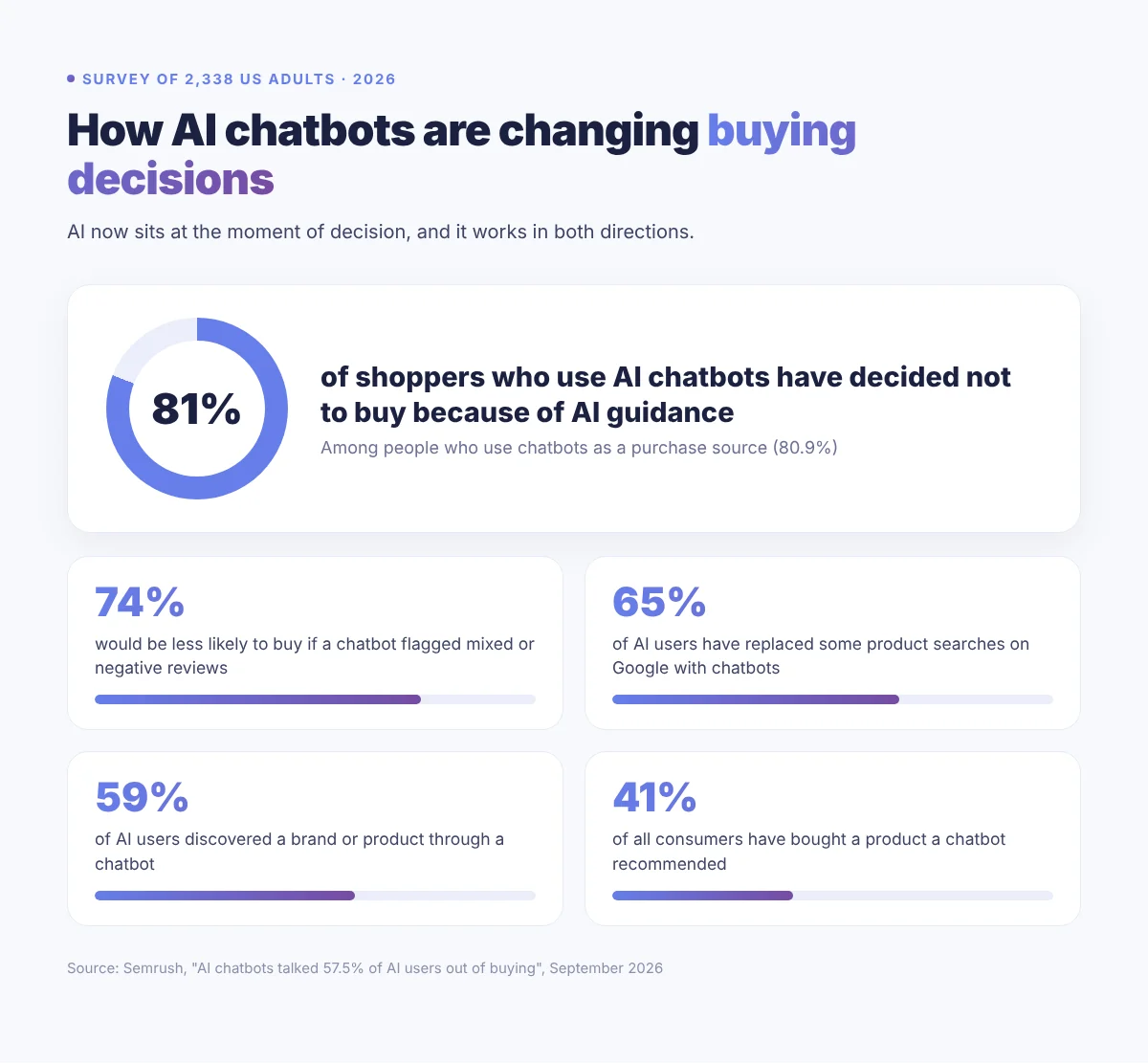
Notice the pattern? AI is influencing purchases in both directions. It sends customers to brands, and it talks them out of buying.
That makes the chatbot the new gatekeeper of your sales funnel. And most brands aren’t managing it at all.
Why AI chatbots talk shoppers out of buying
An AI chatbot has no loyalty to your brand. Its job is to give the user the most helpful answer it can. So when someone asks “Is this worth it?”, it does what a brutally honest friend would do.
1. It surfaces your negative reviews
Chatbots summarise what people say about you across the web. If your reviews are mixed, the AI will say so. And 74% of consumers say that would make them less likely to buy.
2. It compares you with competitors in seconds
What used to take a customer an hour of tabs and comparison sites now takes one prompt. If a competitor has clearer pricing or better reviews, the AI will recommend them instead.
3. It can’t answer the emotional questions
Buying decisions aren’t purely logical. Your customer is also asking: “Can I afford this? Will I regret it? Is this right for me?”
A general chatbot doesn’t know their budget, their goals or their doubts. When it can’t reassure them, the safest answer is often “wait” or “look elsewhere”.
4. Your own website chatbot feels robotic
Many brands added a chatbot that answers FAQs and nothing more. No personality, no questions about the customer, no way to reach a human. If your own assistant can’t help someone decide, they’ll go back to ChatGPT. And ChatGPT doesn’t work for you.
The opportunity: customers research with AI, but decide with trust
Here’s the good news. Customers clearly want AI help. 65% of AI users have replaced at least some product searches on Google with chatbots, according to the same study.
But research and decision are two different moments:
- Research is logical: features, prices, comparisons. AI is great at this.
- Decision is emotional: confidence, reassurance, fit. Humans (or AI that feels genuinely personal) win here.
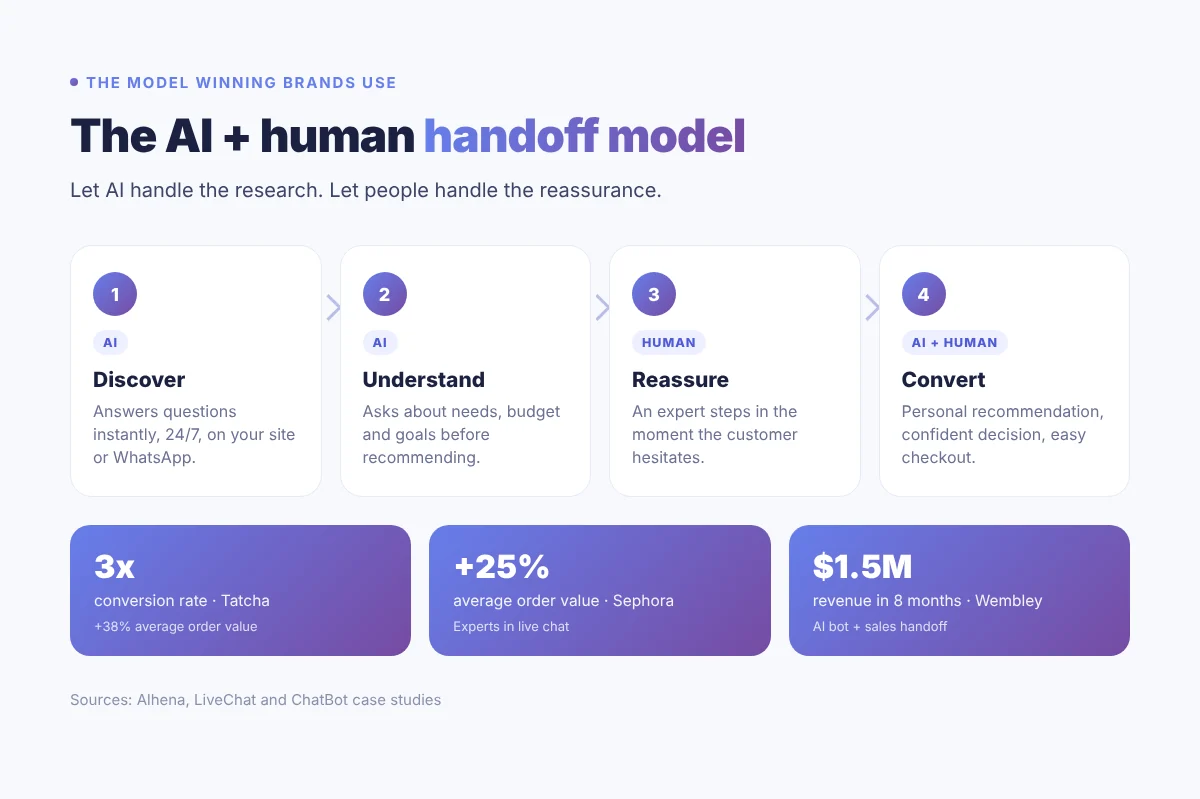
The brands growing right now aren’t choosing between AI and people. They use AI to do the research work, then make it effortless to reach a human for the final reassurance.
What winning brands do: the AI + human handoff model
Tatcha: 3x conversion with a personalised AI assistant
Luxury skincare brand Tatcha launched an AI shopping assistant that starts with a short skin assessment, asks a couple of adaptive questions, then builds a personalised routine. Chats move to a human agent on request.
The result, as reported by its AI provider Alhena: 3x the site-average conversion rate, 38% higher average order value, and 11.4% of total site revenue influenced by the assistant.
Sephora: human experts in the chat window
When its stores closed during lockdown, Sephora put make-up and skincare experts into live chat to recreate the in-store consultation online. According to LiveChat’s case study, the programme is credited with a 25% increase in average order value, and customer satisfaction climbed from around 75% to over 90%.
The lesson: the reassurance moment is worth investing in.
Wembley Stadium: AI first, sales rep second
Wembley Stadium trained an AI chatbot on its own business data to handle around 12,000 chats a month. Qualified visitors are passed to a live sales representative. The team reports over $1.5 million in revenue from chat within eight months.
See the common thread? Personalisation + an easy route to a human.
How to stop AI chatbots from costing you sales: 6 steps
Step 1: Ask ChatGPT about your own brand
Open ChatGPT, Gemini and Perplexity. Ask “Is [your brand] worth it?” and “What’s the best alternative to [your product]?” Write down what they say. That’s exactly what your customers are hearing.
Step 2: Fix the reviews AI is reading
Ask happy customers for reviews on Google and the platforms that matter in your industry. Reply to negative reviews publicly and professionally. AI summarises the overall picture, so volume and recency count.
Step 3: Publish answers, not just adverts
Create clear pages on pricing, comparisons and “who this is for”. AI chatbots quote content that directly answers questions. This is the core of Generative Engine Optimisation (GEO).
Step 4: Make your own assistant ask questions
A good AI assistant behaves like your best salesperson. It asks about the customer’s needs, budget and goals before it recommends anything. Tatcha’s skin assessment is a great model to copy.
Step 5: Build in a human handoff
Add a clear “talk to an expert” option on WhatsApp, live chat or a booking link. The moment a customer hesitates is the moment a person should step in.
Step 6: Measure what the assistant influences
Track conversations, handoffs and sales that started in chat. Without tracking, you can’t tell whether your AI is helping or quietly losing deals.
A word of caution on chatbot ads
Ads inside AI chatbots are coming fast. But be careful: in the same survey, 42% of consumers said they dislike chatbot ads, and two thirds of those said ads make them doubt the AI’s answers. Earning the recommendation organically is still the stronger play.
Frequently asked questions
Do AI chatbots really stop people from buying?
Yes. In Semrush’s 2026 survey, 81% of people who use AI chatbots as a shopping source have decided against a purchase based on AI guidance, and 57.5% of all AI users have done so.
How can a brand influence what ChatGPT says about it?
Improve your reviews, publish clear answer-style content (pricing, comparisons, use cases) and keep your information consistent across the web. This is known as Generative Engine Optimisation, or GEO.
Should small businesses add an AI chatbot to their website?
Yes, if it asks questions, gives personalised answers and hands off to a human when needed. A generic FAQ bot with no way to reach a person usually does more harm than good.
What is the AI + human handoff model?
It’s an approach where AI handles discovery and research questions, then passes the customer to a person for reassurance and the final decision. Brands like Tatcha and Wembley Stadium use it to lift conversions.
Conclusion
The 81% figure isn’t a reason to fear AI. It’s proof that AI now sits right at the moment of decision.
The brands that win won’t be the ones with the most automation. They’ll be the ones that use AI to understand customers better, and keep a human ready for the moment that matters.
So here’s my question for you: have you checked what ChatGPT says about your brand this week?
Want an AI assistant that actually sells?
I help businesses set up AI assistants and automations that answer customers 24/7, qualify leads and hand the right conversations to your team. Tell me about your project and I’ll come back to you within 24 hours.