
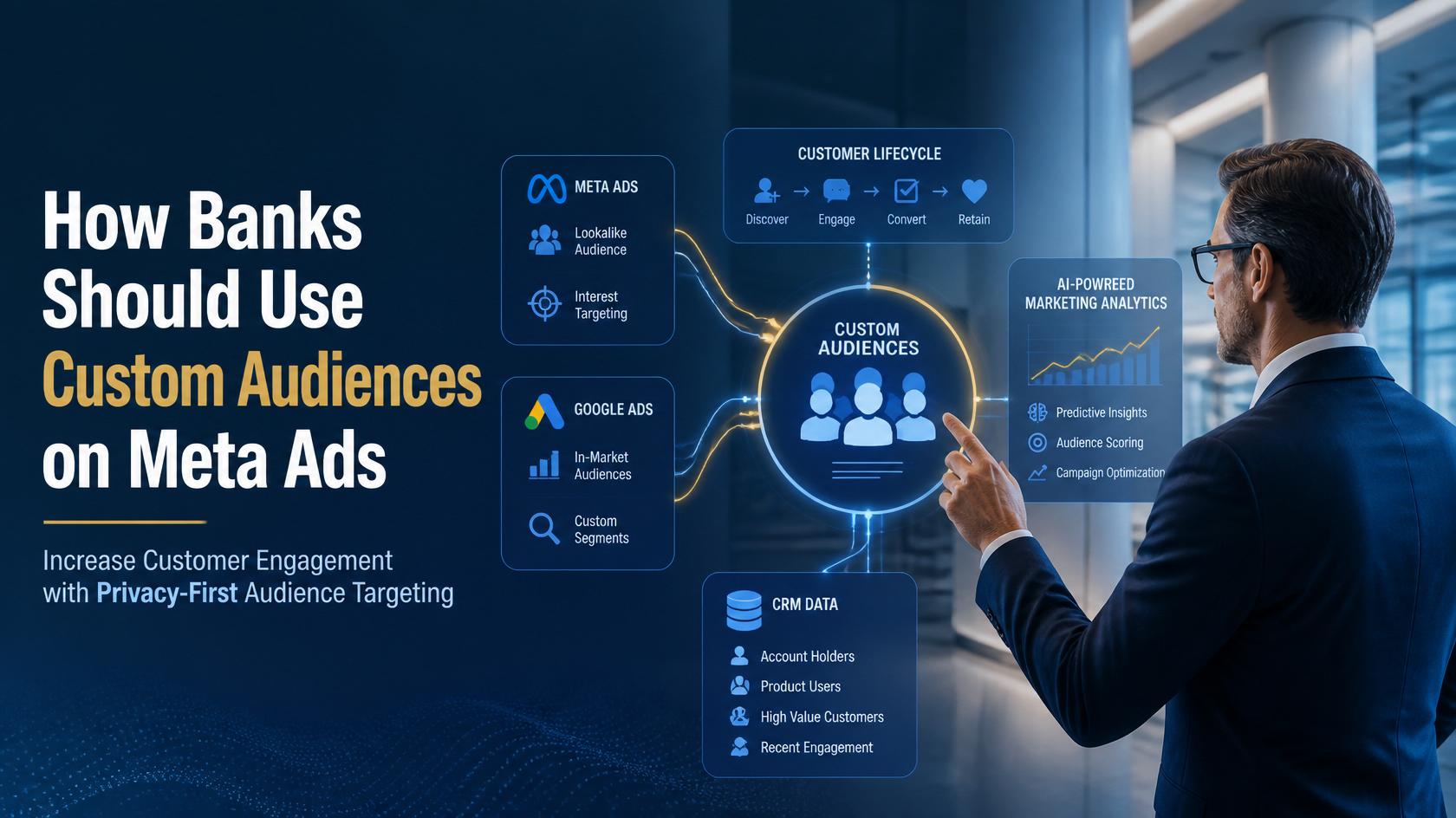
Retail banking is one of the highest-CPA, highest-consideration verticals on Meta. Custom Audiences are the single biggest lever banks must stop paying for reach that will never convert — and start paying for intent.
Note: the screens below are illustrative navigation mockups built to match Meta Ads Manager’s current layout and terminology, not live screenshots — Meta’s interface changes frequently, so always confirm exact labels against your own Ads Manager account.
Why Generic Targeting Fails Banks
Most retail banks still run Facebook and Instagram campaigns on broad interest and demographic targeting: age brackets, “finance” interests, lookalikes of a Page’s fans. On a low-consideration product this is inefficient. On a bank account, home loan, or credit card, it is expensive in a way that shows up directly in cost per approved application.
A prospect who has never visited the loan calculator, never opened the banking app, and has no relationship with the brand is fundamentally a colder lead than someone who started an application and dropped off at the KYC step. Meta’s Custom Audiences let a bank build campaigns around that difference in intent, rather than guessing at it through demographics.
The Three Custom Audience Building Blocks
• Customer list audiences — Meta only ever matches hashed identifiers — a bank’s own PII (email, phone, account number) is never exposed on-platform, provided it is hashed correctly before upload or sent server-side via the Conversions API.
• Website & app activity audiences — Built from the Meta Pixel and, more reliably post-iOS 14.5, the Conversions API — visitors to specific pages (loan calculator, card comparison, account opening flow) or specific events (application started, application submitted).
• Engagement audiences — People who watched a video past a threshold, opened a lead form, engaged with the Page or Instagram profile, or used the in-app events sent via the Meta SDK.
Every use case below is a combination or exclusion built from these three blocks.
High-Impact Use Cases for a Bank’s Media Plan
Mapping Audiences to the Funnel
Every Custom Audience should be assigned a funnel stage and a KPI before it goes live. Without this, teams end up judging a cold prospecting audience by conversion rate, or a bottom-funnel retargeting audience by reach — and drawing the wrong conclusions from both.
Funnel Stage Custom Audience Source Campaign Objective Primary KPI
TOFU Lookalike (1–3%) of high-value customer list Awareness / Reach CPM, reach, video views
MOFU Website visitors: loan calculator, card comparison page Traffic / Engagement CTR, cost per landing page view
MOFU Video/Page engagers (25%+ view, IG saves) Lead generation Cost per qualified lead
BOFU Abandoned application / KYC flow (Pixel + CAPI) Conversions Cost per completed application
BOFU CRM segment: pre-approved offer, renewal window Conversions CPA, approved-loan rate
Retention Existing customers — engagement/cross-sell only Engagement Product adoption rate
Compliance: The Part Banks Cannot Skip
Financial services sit in a more constrained position on Meta than most advertisers, and getting this wrong carries regulatory as well as platform risk.
• Hash everything — Never upload plain-text PII. Use Meta’s on-platform hashing in Ads Manager or, preferably, send events server-side via the Conversions API with SHA-256 hashing applied before transmission.
• Consent is not optional — Only use customer data for marketing where the customer has consented to that use under the bank’s privacy policy and the applicable data protection framework. Maintain a suppression list for opt-outs and sync it on every audience refresh.
• Declare Special Ad Category where it applies — Meta requires credit, employment, and housing-related ads to be flagged under the Special Ad Category, which restricts age, gender, ZIP/postal code, and some lookalike and detailed-targeting options. Loan, credit card, and mortgage campaigns typically fall under this category — declare it correctly at campaign creation, not after a rejection.
• Refresh and expire audiences on a schedule — Set a refresh and expiry cycle for uploaded customer lists and website audiences (commonly 30–90 days) so campaigns are never running against stale or withdrawn-consent data.
• Prioritise the Conversions API over Pixel-only tracking — Browser-only Pixel tracking under-reports conversions due to iOS tracking restrictions and browser privacy changes. Server-side event matching via the Conversions API is now the baseline, not an enhancement.
A Practical Rollout Checklist
☐ Install the Meta Pixel and Conversions API on all digital account opening, loan application, and card application flows
☐ Define and tag key events: application started, KYC step reached, application submitted, application approved
☐ Build an exclusion audience of existing customers for every acquisition campaign
☐ Build a CRM-based lookalike seed from your highest-value, most active customer segment — not the full customer base
☐ Set up an abandoned-application retargeting campaign with a benefit-led, objection-handling creative
☐ Confirm Special Ad Category is correctly declared on every credit, loan, and mortgage campaign
☐ Set a 30–90 day audience refresh cadence and connect it to your consent/suppression list
☐ Feed offline conversion data (approved loans, activated accounts) back into Meta so optimisation targets real business outcomes, not landing page submissions
Custom Audiences don’t replace a bank’s brand and awareness campaigns — they make the performance layer underneath them dramatically more efficient. The banks that win on Meta in the next few years won’t be the ones with the biggest budgets; they’ll be the ones with the cleanest event data and the most disciplined audience architecture.